I choose to use your family as a case study to help you understand Nigeria’s economic journey and, ultimately, draw your own conclusion about where we are today. If you think your family—Nigeria—has actually done well economically and has been on the right path, then consider a common statement we often hear from some of our older people: “We were richer when we were young.”
When you hear such a statement, you can literally decipher that the person is probably not as financially buoyant today as he or she was in the past. That is why the person remembers those years as a period when life was better.
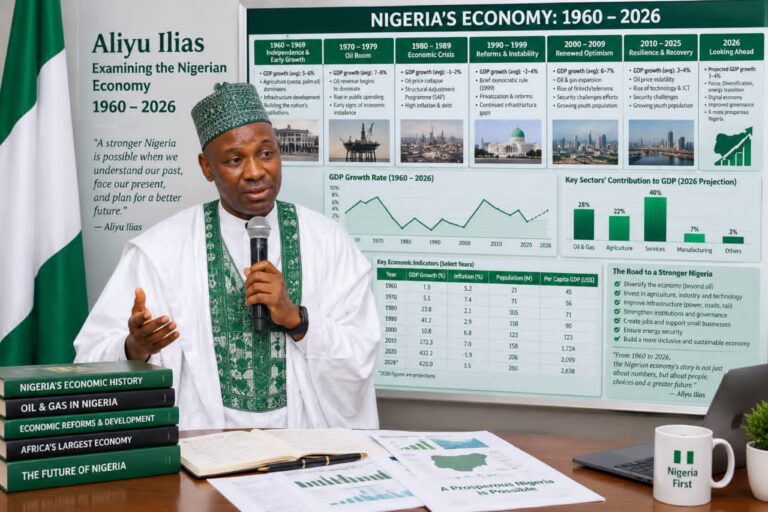
But, as a family, you do not want your story to become: “We were rich in the past.” You want your family to become progressively stronger, wealthier and more prosperous with each generation. So, let us take a journey through your family’s 66-year economic history—from 1960 to 2026.
Your family started on a good note in 1960; agriculture was the major economic backbone of the family. Cocoa came largely from the South, groundnuts from the North, palm produce from the East, while other agricultural products were produced across the country and exported to earn foreign exchange.
Nigeria had a productive agricultural economy and was able to generate substantial export earnings. The Nigerian currency was also relatively strong at the time, reflecting the country’s economic position and relationship with the British pound.
In simple terms, your family had a productive foundation: you had land, you had farmers, you had agricultural products, you had export markets, and you had different sources of income spread across the country. That was a good foundation for building long-term family wealth.
1970–1979: The family discovered oil, then came another major turning point. Between 1970 and 1979, your family discovered that it could make much more money from another resource oil, this was the period of the oil boom, and oil rapidly became the dominant source of government revenue and foreign exchange. With the huge increase in oil earnings, Nigeria began to spend more money on infrastructure and development.
It was during this period that the famous statement attributed to the then Head of State, General Yakubu Gowon, captured the situation: “The problem of Nigeria is not money, but how to spend it.”
Unfortunately, this was also the period when the family began to lose sight of one of its most important sources of sustainable income, which is agriculture. The family had suddenly found wealth and began to behave like someone who suddenly became rich.
Just like a member of a family who receives a large inheritance and begins to spend without thinking about the future, Nigeria increasingly depended on oil while agriculture received less attention. The family began to forget where it came from.
The 1980s: The Family Learnt a Hard Lesson. By the 1980s, your family began to learn the hard lesson of poor planning. The fall in global oil prices exposed Nigeria’s excessive dependence on oil. Government revenues came under pressure, external imbalances increased, and the economy experienced serious difficulties.
In 1986, the government under the leadership of General Ibrahim Babangida introduced the Structural Adjustment Programme (SAP). The programme was designed to respond to the economic crisis and address major structural weaknesses in the Nigerian economy.
But the important lesson for your family was becoming clearer: You cannot build sustainable family wealth by depending overwhelmingly on one source of income. When the price of your major source of income falls, the entire family suffers; this lesson remains relevant to Nigeria today.
By the 1990s, the consequences of neglecting agriculture and failing to sufficiently transform oil wealth into broad-based and sustainable development became increasingly visible. Economic growth remained weak for much of the period. Investment suffered, particularly outside government-controlled sectors, while infrastructure such as roads, healthcare and education faced serious challenges. Inflation became a growing concern, and unemployment increasingly affected Nigerian households.
Your family had made money from oil, but the question is where was the sustainable wealth?
Where were the industries that could employ millions of people? where were the strong agricultural value chains? where were the world-class roads, schools, hospitals and productive businesses that could continue generating wealth for the next generation?
The family had another opportunity, but the question remained whether it would use that opportunity wisely.
The 2000s brought another important economic turning point. under President Olusegun Obasanjo, Nigeria implemented significant reforms, including debt relief, banking-sector reforms and telecommunications expansion. These reforms coincided with a period of relatively high global oil prices.
The combination helped Nigeria achieve strong economic growth, while the telecommunications revolution transformed communication and opened new opportunities for businesses and households. Nigeria’s economic performance during this period attracted significant international attention. The family appeared to be getting another opportunity to build lasting wealth.
But once again, the question was not simply how much money the family was making.The bigger question was:Was the family building an economy capable of creating wealth beyond oil?
Nigeria continued to experience periods of economic growth, but many of the structural weaknesses remained. In 2014, Nigeria rebased its GDP and became Africa’s largest economy by nominal GDP at the time, however, the size of the economy did not automatically translate into prosperity for every household. The family was getting bigger, but many members of the family were still struggling to meet their basic needs. A bigger family income does not necessarily mean that every member of the family is becoming richer.
Another major shock in 2016, Nigeria experienced a recession following the collapse in global oil prices and disruptions in oil production and the family’s dependence on oil became obvious and the lesson kept repeating itself:
Just as the family was trying to recover, COVID-19 arrived, the pandemic disrupted businesses, supply chains, international trade and household incomes. Nigeria, like many countries around the world, experienced significant economic difficulties, inflationary pressures increased, businesses struggled, and households faced growing financial pressure.
The pandemic demonstrated another important reality, a strong economy is not only about the amount of money coming into the family; it is also about how resilient the family is when an unexpected crisis occurs.
A wealthy family without savings, diversified income and productive assets can quickly find itself in difficulty when a major shock occurs.
2023 The Family Is Reforming Again , we arrived at the present chapter of the family story. from 2023, Nigeria entered another major period of economic reform, including the removal of petrol subsidies and significant foreign-exchange reforms. These reforms have brought substantial challenges for Nigerian households and businesses, particularly through inflation and the rising cost of living. For many families, the cost of food, transportation, housing, education, and other basic necessities has become a major concern.
At the same time, the reforms are intended to address longstanding structural problems and create a more sustainable macroeconomic framework over the longer term.
But for the ordinary Nigerian family, the question remains: When will the benefits of economic reform translate into better living conditions? This is where the success of the family should ultimately be measured, not only by macroeconomic indicators, but by the quality of life of the people who make up the family.
Having travelled through the economic trajectory of this family called Nigeria in 66 years, you will probably agree with me on one thing. Nigeria must become more intentional about its economic development.
We have natural resources., we have a large and youthful population., we have human capital, we have entrepreneurs, we have agricultural land, wee have oil and gas, we have mineral resources.
We have Nigerians succeeding globally in virtually every profession, so why should a family with all these resources continue to struggle to feed itself, create enough productive employment and provide a decent standard of living for its members?
The answer is not simply that Nigeria lacks resources.
The bigger challenge is how we manage, transform and distribute the value created from those resources.
So, after 66 years, let me ask you a simple question:
If Nigeria were your own family, would you say the family has become richer or merely earned more money?
Would you be satisfied if your family could say, “We were richer when we were young” or would you want your children to say: Our parents built a stronger economic foundation for us, and we are better off because of what they built”
*Aliyu Ilias, PhD, an Economist and Public Affairs Analyst, writes from Abuja